TOC
Why Build One Game When You Can Build All the Games?
🕹️ Why Build One Game When You Can Build All the Games?
You have a notebook — or a Notes app, or a Discord full of half-finished pitches — with ten game ideas in it. You have shipped zero. Not because the ideas are bad, but because every single one starts in the same place: collision, a camera that doesn't make people seasick, materials that aren't flat gray, footstep sounds, a sky. You burn three weekends re-solving the boring 20% and never reach the part that was actually your idea.
So here is the bet I am making out loud: don't build one game. Build the engine that builds all of them. Solve the boring 20% once, in the open, and every idea after that gets cheaper.
It is real, it is open source (React Three Fiber on Three.js), and you can clone it today. And because a game engine with no game is just a README, I built a whole playable 3D city on it as proof. You can walk it right now — first person, in a browser tab, nothing to install.
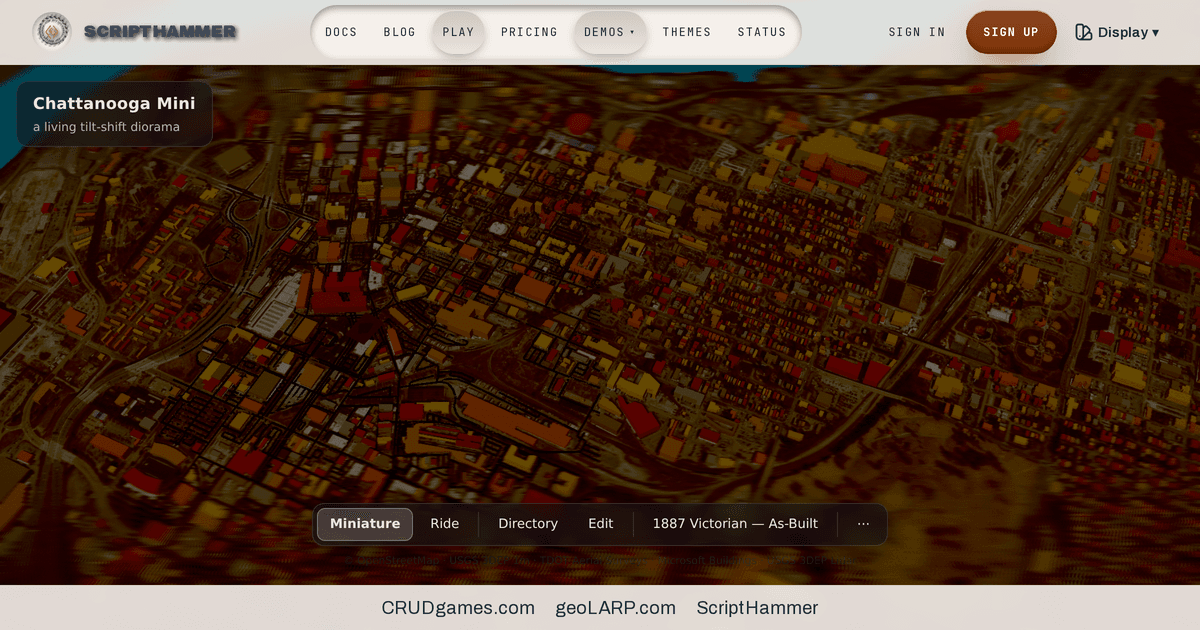
The city is the demo, not the point. The point is the engine underneath it — the same one that runs a bare test level with no city at all.
🎮 The engine is the actual point
The thing that makes any of this move is a small, honestly-scoped game toolkit called CoD. It is asset-free and procedural: the materials, sky, and sound are generated on your graphics card and CPU at load time, so it ships zero texture, model, or audio files. That is why a whole playable city fits on a static site with no server behind it, and why cloning it doesn't mean downloading a gigabyte of assets.
Here is what it actually gives you today, and it is more than a tech demo:
- 🧱 Physics and collision — a fast static-world spatial index plus swept-capsule collide-and-slide, so you don't fall through walls or tunnel through corners.
- 🚶 A first-person controller — walk, sprint, crouch, go prone under a low overhang, and hop on a bike. Real ground contact and step-ups.
- 🎨 A procedural material forge — physically-based textures (color, normal, roughness) generated on the fly, no image files.
- 🌤️ An atmospheric sky with image-based lighting, procedural footstep and ambient audio, graphics-card particles (dust, weather), and camera feel (head-bob, landing punch) — the small stuff that makes a scene feel alive.
- ⚙️ An event bus and four quality tiers (
?q=low…ultra) so it scales from a laptop to a desktop.
@/lib/cod.
Now the honest part, because overpromising is exactly the thing I want to teach you to spot: this is not a finished general-purpose engine, and I am not going to pretend it is. Today it is a strong first-person, 3D, walking-and-riding foundation. It has no entity system, no save format, no multiplayer, no 2D, and no model or animation loaders yet. "All the games" is the ambition, not a shipped fact. That gap is not a disclaimer — it is the invitation. Come build the missing layers with people who will review your work.
🏙️ Proof it's reusable, not a one-off
A toolkit that only runs the thing its author built is a lie you tell yourself. So here is the check: the exact same engine drives two completely different scenes.
One is a bare test level — a floor, a step, a wall, a crate, and a low bar you have to crouch under. No city, no data, just the engine proving it walks, collides, and crouches.
The other is Chattanooga: roughly 8,000 buildings at real rooftop heights, pulled from OpenStreetMap footprints, lidar heights, and United States Geological Survey elevation. Same physics, same controller, same sky and audio, pointed at a real city instead of a box. If it can carry 8,000 real buildings and a bike, it can carry your idea.
🧪 It's a beta — here's the first bug
Shipping something rough and asking people to break it is itself a best practice, so let me practice it. Right now, first-person Walk mode has a real bug: sometimes it spawns you below the city and you just fall — the whole thing hangs above you like a floating island while you drop through the sky. I hit it myself:
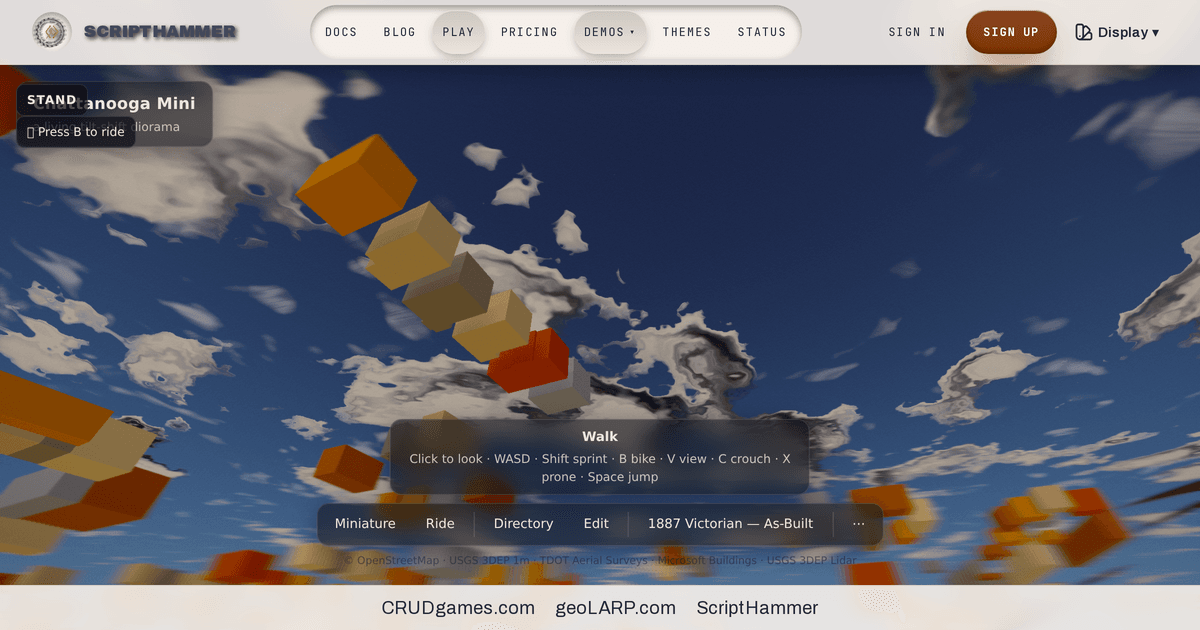
You press B to ride the bike, and the bike rides off through the sky. Spawned below the city, falling — at a smooth 60 fps, so the frame rate is fine and the spawn is just wrong. This is the reason to play a beta, not the reason to skip it.
So I did the exact thing I am about to ask you to do. I filed it as a bug report: issue #651. Open it and look at the shape of it, because that shape is the whole ask:
- Where you were — the URL (
/chatt?diorama&walk). - What you did — opened it, clicked to look, pressed WASD.
- What you expected vs what actually happened — "spawn on the street" vs "fell through the sky."
- Your setup — browser and graphics card. It matters more than you'd think; the same scene runs very differently on different hardware.
- A screenshot, if you can grab one.
Here's the ask, concretely:
- 🎯 Play it — and yes, you might fall through the world first. Try anyway: press B for the bike, V to watch yourself go.
- 🐛 File what broke on the issues page, in the shape above. Finding a new one is genuinely helpful.
- 💬 Not sure it's worth a full report? File it anyway — a rough note beats staying quiet.
🧠 The skill isn't prompting. It's telling slop from craft.
Honest meta-layer, since this is a teaching project: AI helped build a lot of this, including drafts of this post. Left unchecked, AI produces slop — output that reads right and is confidently wrong. This post tried it. An early draft cheerfully told you to "ride a bike through downtown." You just saw the screenshot: the bike drops you through the sky. The sentence was fluent. It was also false.
Fluent versus true is the whole game, and it's the actual skill I want to teach — not "how do I prompt the robot," but "how do I know if what came out is real?"
- Slop says "it works." Craft writes a test that fails when it doesn't.
- Slop makes a confident claim. Craft checks it against the source and links it.
- Slop hides the rough edge. Craft files the bug with steps to reproduce, like #651.
- Slop invents specifics. Craft says "I don't know yet," then finds out.
🚀 You don't need money to get in
Back to you and your notebook of ideas. Here's the part I care about most: the price of admission isn't cash. Learning is free, and the most valuable thing you can bring to an open-source engine isn't a credit card — it's another set of eyes and another game idea stress-testing it.
The cheapest way in is also the best one. Clone ScriptHammer, read the source, and watch me build it live on Twitch. It is MIT — take it, ship it, keep it. No dollars required, ever.
Short on cash? Trade instead. Playtest this and file a good bug. Fork it and prototype your idea. Build one of those missing layers — a save system, a third-person camera, an enemy. Every playtester is another set of eyes, every fork is street cred you earn in public, and more people in the project make the engine better for everyone.
If you'd rather have hands-on help on your game, there's a paid lane too: live Office Hours (bring a goal, leave with something running, the recording is yours to keep), and Field Study for a bigger build done with you. Prices are on the pricing page, and if cash is tight, see two paragraphs up — trade instead. The paid tiers exist to fund the free ones, not to gate them.
💬 Come build it
- 🎮 Try the engine demo — the bare test level, no city.
- 🚲 Play the city — first person, press B for the bike.
- 📦 Clone the engine — MIT, asset-free,
@/lib/cod. - 📺 Watch me build it — live on Twitch.
- 💳 See what help costs — free to Office Hours to done-for-you.
- 🗺️ Read the brainstorm that started this.
